In recent years, the Theology Department at St. Pius X Catholic High School began to notice a gap between what students were learning in theology class and how confident parents felt talking about the faith at home. That realization came into focus based on observations from Mini-Class Night, the school’s annual curriculum evening when parents walk their student’s schedule and spend a few minutes in each class. After visiting theology classrooms, parents across all grades consistently expressed curiosity and excitement about the curriculum.
“We had parents come out saying, ‘Oh my gosh, this is what you talk about? I didn’t know that was part of our faith. I wish I could sit in this class,’” Theology Department Chair Mrs. Lindsey Farrell said. “We heard that again and again. It made us ask, how do adults learn theology anymore? What was the last thing you learned [about the faith]? And what if you’re a parent who believes in the mission of a Catholic school but never attended one yourself?”
Those conversations led to the creation of Theology 101, a program built to support parents in their role as the primary educators of the faith by offering accessible opportunities to learn the same core teachings their students encounter in class.
“We just wanted to be able to share the theology that we’re teaching in the classroom with the parents,” theology teacher Ms. Molly Clavenna said. “A lot of parents aren’t necessarily having those conversations with their students, so we wanted to give them things they could talk about at home and help foster that faith relationship.”
The first Theology 101 session was in October of 2023 on a weekday evening in the school cafeteria. The gatherings are intentionally designed for adults, and parents are invited to bring their own food and drinks to create a relaxed, community atmosphere.
Each session lasts roughly an hour and usually follows the same format designed as a mini-classroom lesson.
“We start just like our students do in classes, with prayer,” Mrs. Farrell said. “We then go into some sort of activity to engage whatever topic we’re doing followed by a short presentation, no more than a 20-minute lecture from different voices, and then a small group type of reflection, a debrief, and end night with a tie-up and a send-off.”
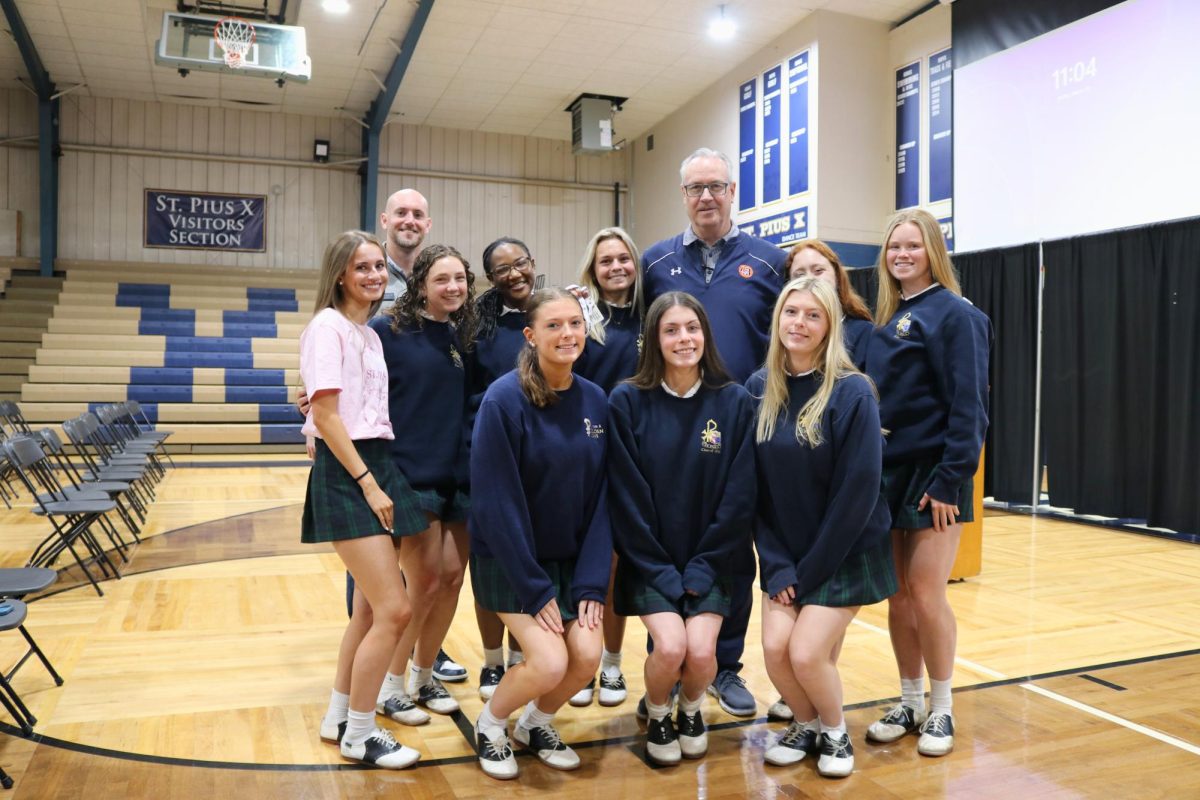
It’s a true group effort from department members, and they all showcase their talents in different ways. One or two will present the formal topic, a few others will lead opening prayer or be in charge of the opening activity, and some may not be present on the night of the event but are involved in the planning process or putting together the resources used with parents.
Topics have included the origins of the Mass, the true meaning of the Eucharist, and a session titled “What Do the Bishops Say?” that examined the Church’s guidance on contemporary talking points, such as Pope Francis’ letter to U.S. bishops on immigration and the broader Gospel calling to protect human dignity, as well as Magisterium AI, a tool for accessing a compendium of Catholic-sourced documents.
About 30 people attended the first Theology 101, and the teachers quickly realized that scheduling the best day and time for families was difficult.
“After about two years of trying different days of the week or trying different start times, what we decided this past spring was to evolve the program to hosting only one in-person event per semester [instead of two], and then a podcast that we would release monthly, so that if you were a parent who couldn’t attend one of the sessions, now in only 15-20 minutes, you can still get in on that theological conversation with us,” Mrs. Farrell explained.
They launched their first Theology 101 podcast on Spotify this August, titled “What is Theology?”
“We did the first one just as a tester, and people were really responsive. It was easier than showing up at school for a night,” theology teacher Mr. Matthew Lawson said.
Each episode lasts less than 25 minutes and features a small group of theology teachers discussing topics such as “Mary, the Mother of God,” “Made in God’s Image,” and “The Culture of Catholic Education.”
Mrs. Farrell said she’s not worried about running out of subjects to cover because their department “is a group of theology nerds.”
“We have a dream wall of 1,000 things we’d love to tell our families about, but we don’t have the in-person sessions planned out for the year. We have probably three or four that we think this year we want to talk about, but to use two Catholic words, we really do discern what the needs of the community are, and then together as a department, pray and listen to what we’re hearing in the classroom,” she said.
For example, they decided to focus on the Mass for the most recent Theology 101 session in October for two important reasons.
“Number one, the data is showing people are slowly starting to return to Mass since Covid days, but also, how many people say they’re practicing Catholics and aren’t going to Mass? So maybe [we can] dispel what Mass is and isn’t,” Mrs. Farrell said.
“And then the other side of it is that our population at Pius is changing to be a lot of non-Catholics, which is beautiful,” she continued, “so why can’t those parents learn about ‘this Mass thing’?”
They take a different approach to their podcast topics and map out all five episodes for the semester at one time.
“We’re trying to build at least an arc, kind of like how podcasts are more connected than one-off events, so we’re trying to make sure that they all flow into each other, or at least build on each other in some sort of thematic way,” she said.
Mrs. Farrell said her vision for Theology 101 is to build a collection of resources to help families feel more knowledgeable and better prepared to teach and learn alongside their students about the Catholic faith. The department is currently working on developing materials for parents of recent high school graduates.
“We had parents with recently-graduated alumni ask us how they can help their children transition to a university where they’re no longer in a Catholic bubble,” Mrs. Farrell said. “We love that! That’s a great question!”
What began as a simple idea five years ago has become a meaningful extension of the school’s mission. By helping parents grow in their understanding of the faith, Theology 101 strengthens the partnership between home and school and supports families in guiding their children spiritually, academically, and personally.